

Global Broker Regulation Inquiry App
About WikiFX
English
简体中文
繁體中文
English
Pусский
日本語
ภาษาไทย
Tiếng Việt
Bahasa Indonesia
Español
हिन्दी
Filippiiniläinen
Français
Deutsch
Português
Türkçe
한국어
العربية
اردو


Why Do Forex Brokers Show Different USD/MYR Quotes?

WikiFX
|


Abstract:Forex beginners often wonder why two platforms show slightly different USD/MYR prices. This article explains that quotes are built from multiple liquidity providers, each with its own view, and that broker markups and commission models cause normal, small variations. The key is to compare total trading costs, not just the displayed spread.
 Contents
Why Do USD/MYR Quotes Differ Across Platforms?
Imagine you have two trading apps open on your phone. You look at the USD/MYR pair. One shows 4.4100 / 4.4200, the other shows 4.4090 / 4.4180. Your first reaction might be: is one broker wrong? The short answer is no. These small differences are normal in the foreign exchange market. We will walk through what causes them and why you should not worry.
What Exactly Is a Forex Quote?
A forex price always comes in two numbers: the bid (the price at which you can sell the base currency, in this case the US dollar) and the ask (the price at which you can buy). The difference between these two is called the spread. For the USD/MYR pair, a spread of 20 to 100 ringgit points, also called pips (short for percentage in point), is common because it is an exotic currency pair with lower trading volume than major pairs.
When you see a price on your screen, you are seeing the brokers best offer. No single authority sets the USD/MYR rate. Instead, thousands of transactions happen every second among banks, funds, and companies. The broker collects these and shows you a quote.
Where Do Brokers Get Their Prices?
The forex market is decentralised. There is no central exchange like Bursa Malaysia for stocks. Large banks and financial institutions trade currencies directly with each other through electronic networks. This is often called the interbank market.
Retail brokers do not typically access this market directly. Instead, they partner with several liquidity providers, which are usually large banks or prime brokers. Each liquidity provider streams its own bid and ask prices based on its own trading positions, market view, and the flow of orders it receives. Because no two providers see exactly the same order flow, their prices are rarely identical.
The broker aggregates these streams and selects the best bid and best ask from the group. Then it may add a small markup to earn its profit. The markup increases the spread you see. Some brokers operate on an ECN (Electronic Communication Network) or STP (Straight Through Processing) model, showing raw spreads but charging a fixed commission per trade. Others use a market maker model where the spread is wider but there is no extra commission.
For the USD/MYR pair, which is less liquid, the differences among liquidity providers can be larger than for the euro or yen. This feeds through to the retail quotes you see.
A Hypothetical Comparison of Two Platforms
To make this concrete, imagine two hypothetical platforms, AlphaFX and BetaTrade. At a given moment, AlphaFX receives the following best bid and ask from its liquidity providers: 4.4100 and 4.4120. AlphaFX operates with a small markup, so it adds 3 pips to the ask. The correct ask becomes 4.4123, and the quote it shows to clients is 4.4100 / 4.4123, giving a spread of 23 pips.
BetaTrade, connected to a different set of liquidity providers, sees a slightly different best bid: 4.4095, and the best ask: 4.4115. BetaTrade passes on these raw prices with no markup but charges a RM10 commission per lot traded. Its displayed spread is 4.4095 / 4.4115, a spread of 20 pips.
The difference in the ask price is now 8 pips (4.4123 vs 4.4115). This is small in percentage terms but might catch a beginners eye. Neither platform is doing anything wrong. They are simply reflecting different liquidity sources and different business models.
Note: All numbers used here are purely hypothetical and should not be taken as actual market rates.
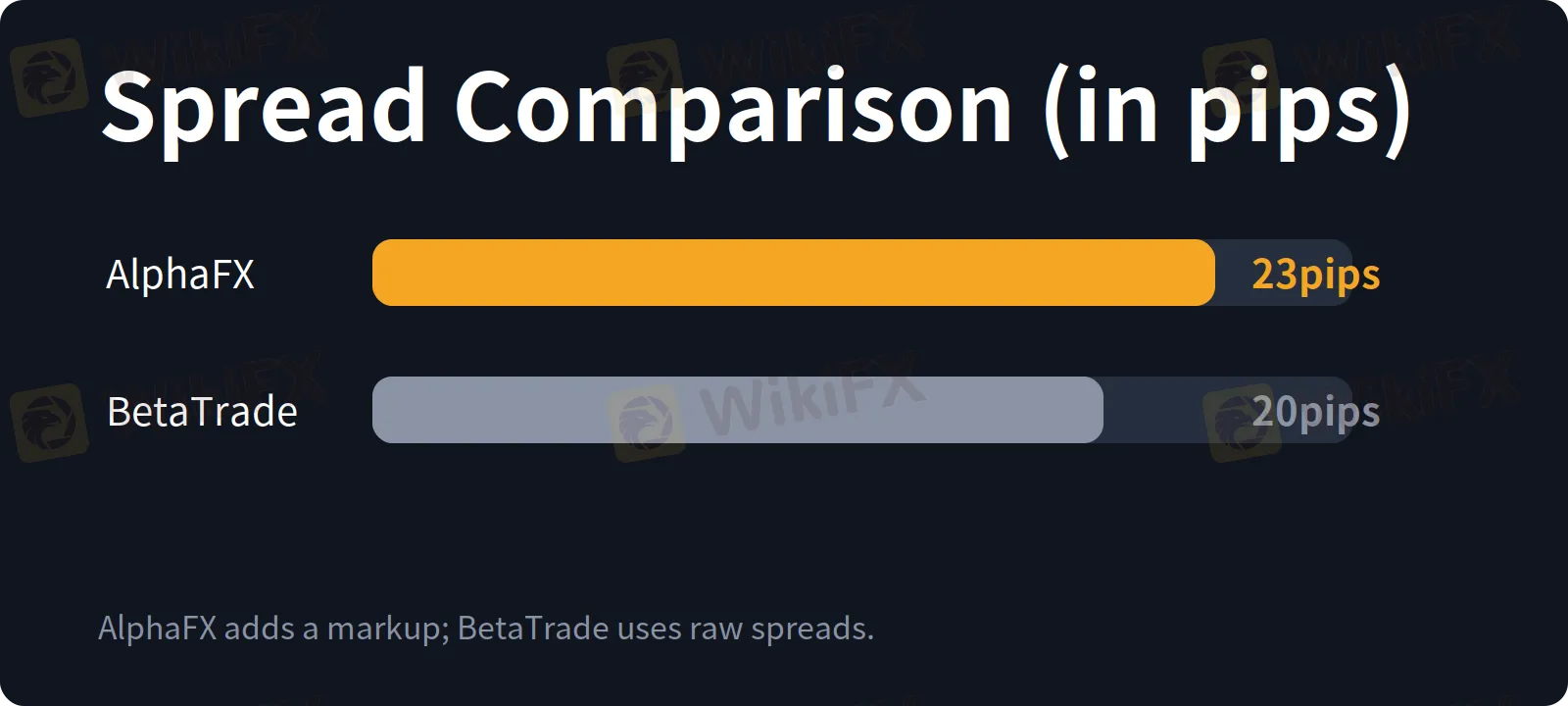
Hypothetical spread comparison between two platforms.
Common Misunderstandings That Beginners Should Avoid
- “All brokers should show the same price.” This would only happen if there were a single central exchange. The forex market works differently. Slight differences are a natural result of decentralisation.
- “A wider spread means the broker is cheating.” A wider spread can simply reflect the brokers cost structure. If a broker does not charge commission, it must cover its costs through the spread. A spread-only broker may advertise a wider spread but still be cheaper overall once all costs are tallied.
- “A difference in quotes means an arbitrage opportunity.” In theory, you could try to buy on one platform and sell on another for a gain. In practice, retail traders face execution delays, slippage, and platform rules that make such strategies unworkable. The tiny gaps are not realistically exploitable.
What This Means for Your Trading
Small quote differences across platforms are normal and not a cause for alarm. They become a problem only if one platform consistently quotes far from others during calm market hours, which is rare. As a beginner, your focus should be on understanding the total cost to open and close a trade: spread plus commission plus any overnight swap charges. Compare brokers on this total cost, not on the displayed bid-ask alone. And always remember that the quote you see is an indicative price; your order may fill at a slightly different level if the market moves between your click and execution.
A quote difference is a normal reflection of market structure, not a signal of broker dishonesty. Recognise this so that you can choose a broker based on real costs, not on a single snapshot of a rapidly moving market.
Disclaimer:
The views in this article only represent the author's personal views, and do not constitute investment advice on this platform. This platform does not guarantee the accuracy, completeness and timeliness of the information in the article, and will not be liable for any loss caused by the use of or reliance on the information in the article.
WikiFX Broker
Latest News
OtetMarkets Review: Traders Report Frozen Funds and Withdrawal Blocks , Score Sits at 2.00
WikiFXIs Octa Safe for Malaysian Traders? Deep Dive into Octa's Regulatory Status
WikiFXPocket Broker Review: Is Your Deposit Safe?
WikiFXReview 2026: Dollars Markets Regulation, Withdrawal Complaints, and Platform Risks
WikiFXCapital Guard Liquidated: $17.4m Raised, Most Funds Gone
WikiFXSingapore Dollar Holds Tight Range as FOMC Looms
WikiFXHow a 'Legitimate' Investment Became a RM67.5 Million Ponzi Scheme That Scammed 206 Investors
WikiFXRupee Hits Two-Week High as RBI Defends 97 Mark
WikiFXForexMart Review: Profit Canceled, Principal Withheld, and a Broker Warning Traders Cannot Ignore
WikiFXTitan Capital Markets Review 2026: Complaints, Withdrawals, and Severe Risk Signals
WikiFX