

Global Broker Regulation Inquiry App
About WikiFX
English
简体中文
繁體中文
English
Pусский
日本語
ภาษาไทย
Tiếng Việt
Bahasa Indonesia
Español
हिन्दी
Filippiiniläinen
Français
Deutsch
Português
Türkçe
한국어
العربية
اردو


Chasing Price: The Psychology That Sinks New Forex Traders

WikiFX
|


Abstract:Chasing price moves is a common pitfall for new forex traders, driven by fear of missing out and fear of loss. Understanding the emotional cycle and keeping a simple trading journal can help build self-awareness without judgment.
 Contents
The Urge to Chase
You are watching a currency pair move higher. Every tick brings a fresh wave of regret: “If only I had entered an hour ago.” Then the price spikes again. Your heart races. Imagine a trader in that moment opens a long position, acting on the impulse to catch the move. As soon as they do, the price stalls. It wobbles, then drops sharply. They exit in a panic, taking a loss. If this feels familiar, you are not alone. This is the cycle of chasing and selling, one of the most common habits that traps new forex traders.
The Psychology Behind Chasing and Selling
What drives this behavior? Two powerful emotions: fear of missing out (FOMO) and fear of loss. FOMO is the anxious feeling that others are making profits while you sit on the sidelines. It pushes traders to act without thinking. The fear of loss, on the other hand, makes them exit a trade at the worst possible moment because they cannot stand watching the price go against them.
When traders chase a rally, their brain releases a hit of dopamine at the thought of quick gains. This emotional high overrides logical decision-making. They ignore their own plan - or enter without any plan at all. The entry is based on the price movement they are seeing right now, not on any signal or analysis. After they enter, the price often reverses simply because short-term moves are unpredictable. Then the fear of loss takes over. The same intense emotion that drove the entry now screams to exit before losing even more. They close the trade at a loss, and a wave of relief washes over them. But soon, regret sets in. They realize they acted purely on impulse.
This emotional loop is self-reinforcing. The brain remembers the relief of closing the trade, which makes it easier to repeat the same mistakes next time. Over time, this creates a pattern of buying near highs and selling near lows.
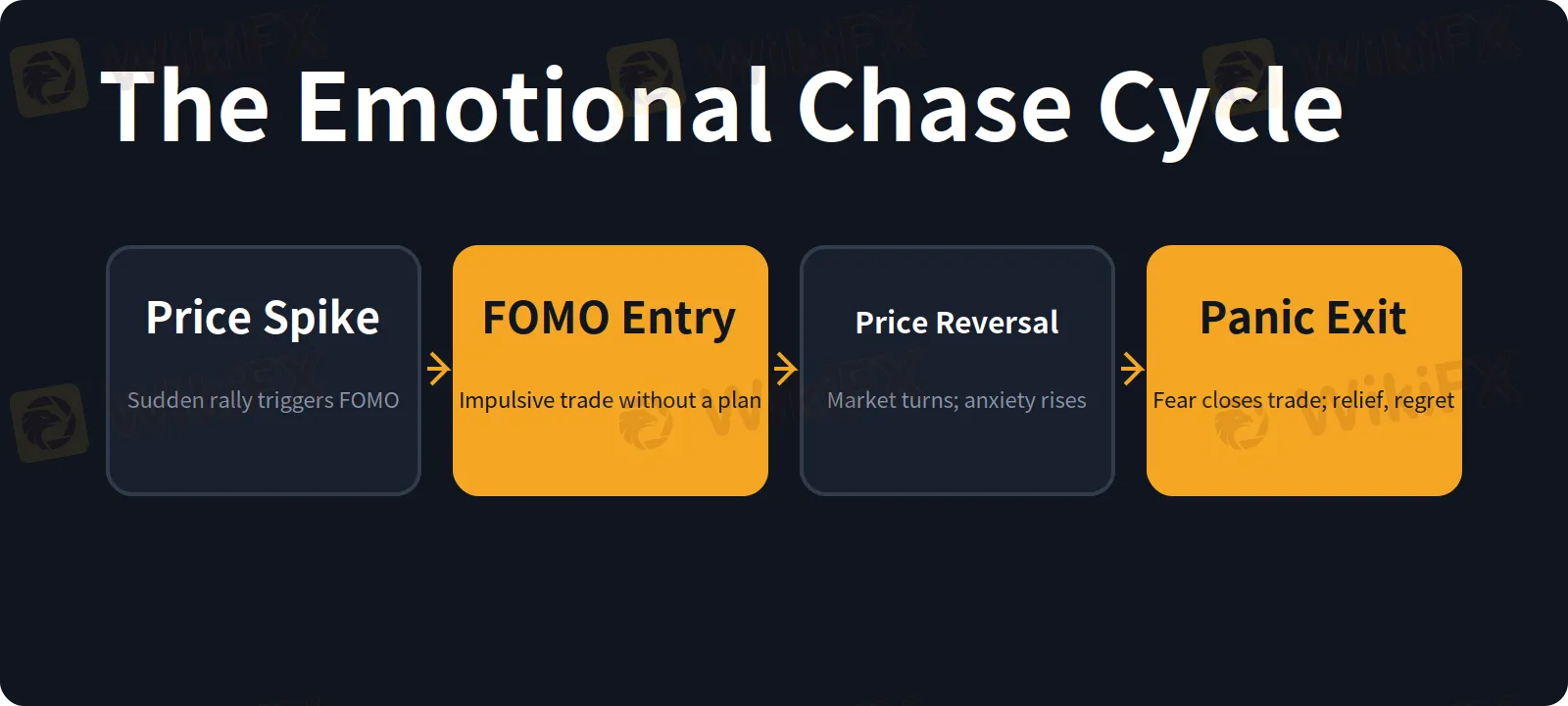
The cycle repeats itself without self-awareness.
A Hypothetical Walk-through
To see how this works in practice, consider the following hypothetical situation. Imagine a trader watching EUR/USD during a news-driven move. The pair has been climbing steadily from 1.1300. The trader had no initial plan, but as the price reaches 1.1350, he starts paying attention. At 1.1385, he feels intense FOMO. He enters a buy trade at 1.1390, convinced the price will hit 1.1450. He has no stop-loss (an order to close a trade automatically at a certain price to limit losses) or clear target.
Minutes later, the pair retreats to 1.1360. The trader is now losing money. He tells himself it will bounce back. It falls to 1.1330. His anxiety spikes. He cannot bear the thought of giving back even more. He closes the trade at a loss of 60 pips (where one pip equals 0.0001 for EUR/USD). Relief follows, but then he sees the price rebound to 1.1410. He feels cheated, angry, and exhausted. This is a fictional, simplified scenario for educational purposes only. The mistake is not the loss itself; it is entering for emotional reasons and exiting the same way.
Building Self-Awareness
The first step in changing a behaviour is to observe it without judgement. As a new trader, you can benefit from simple self-observation practices. These are not rules for making better trades; they are ways to understand your own patterns. Over time, this awareness can lead to more deliberate decision-making.
Start a simple trading journal. After each session, take five minutes to write down:
- What was the trade idea, if any?
- What emotion did you feel just before entering? (excitement, fear of missing out, calm, anxiety)
- What emotion did you feel while the trade was open?
- What made you close the trade? (target hit, stop-loss hit, impulsive fear, boredom)
After a week, look back at your notes. You may notice a pattern. Many traders find that their worst entries coincide with strong emotions like FOMO or panic. The journal does not tell you what to do. It simply reveals the truth of your own behaviour. Once you see it clearly, the choice to pause becomes easier.
The cycle of chasing and selling is rooted in our natural emotional wiring. Financial markets do not reward raw impulse. By becoming an observer of your own mind, you slowly build the mental space to act with intention rather than react to every price tick. This is not about eliminating emotions - that is impossible. It is about recognizing them in the moment so they do not hijack your trading decisions.
Disclaimer:
The views in this article only represent the author's personal views, and do not constitute investment advice on this platform. This platform does not guarantee the accuracy, completeness and timeliness of the information in the article, and will not be liable for any loss caused by the use of or reliance on the information in the article.
WikiFX Broker
Latest News
OtetMarkets Review: Traders Report Frozen Funds and Withdrawal Blocks , Score Sits at 2.00
WikiFXIs Octa Safe for Malaysian Traders? Deep Dive into Octa's Regulatory Status
WikiFXPocket Broker Review: Is Your Deposit Safe?
WikiFXReview 2026: Dollars Markets Regulation, Withdrawal Complaints, and Platform Risks
WikiFXCapital Guard Liquidated: $17.4m Raised, Most Funds Gone
WikiFXSingapore Dollar Holds Tight Range as FOMC Looms
WikiFXHow a 'Legitimate' Investment Became a RM67.5 Million Ponzi Scheme That Scammed 206 Investors
WikiFXRupee Hits Two-Week High as RBI Defends 97 Mark
WikiFXForexMart Review: Profit Canceled, Principal Withheld, and a Broker Warning Traders Cannot Ignore
WikiFXTitan Capital Markets Review 2026: Complaints, Withdrawals, and Severe Risk Signals
WikiFX